Tuesday, June 24, 2014

Classroom Overhaul -- Step 1: Paint the File Cabinets!

One of the big projects on my to-do list this summer was to paint and organize the file cabinets in my classroom. Ughh! This is a project I've been needing and wanting to do for several years, but I've been a little daunted by undertaking such a big task.

Once I got into it, I couldn't believe how easy it was!  The entire process of transforming two UGLY metal file cabinets took about 6 hours.  I love the way they look now! As a bonus, I organized my files as I was putting them back in, and got rid of 2 whole drawers worth of outdated resources.

The tools I used:
drop cloths
spray paint (paint and primer for metal, wood or plastic)
screw driver (to remove the handles
mask


Step 1: Empty and remove the drawers.
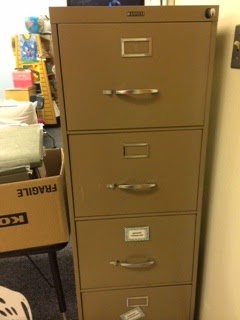

Optional: Remove the hardware. I removed the handles from one set of drawers, but not the other. 


Step 2: Sand and clean the drawers. I used fine grit and lightly sanded the surface. After sanding, I sprayed the drawers with a household cleaner and wiped them down with a paper towel.


Step 3: Spray paint. I selected the colors I use in my my classroom: blue, green, and yellow. I used paint and primer spray paint for wood, metal or plastic.  The drawers only needed about two coats each, but the cabinets took 3-4 coats. I ended up using about 8 cans of paint for the 2 cabinets.  I sprayed the drawers in my classroom. The cabinets were big, so I moved them outside. I used a mask, as recommended when working with spray paint.


And voila! The finished cabinets look great!!


Tuesday, June 3, 2014

Getting Them to Write! Teaching Informative Writing to 1st Graders Through Thematic Units

Summer is the perfect time to reflect on what worked well with  my first graders and what didn't.  One thing that went really well this year was teaching my kids how to write informative pieces.  

Summer is also the perfect time to go back to units that I created early in the year and tweak them. I was doing just that with my Africa unit a few days ago, and I was struck by how far my kids came with their writing this year.  

Take a look at the writing paper that I developed for my beginning first graders in September.  I recall one little guy who looked at me with horror when he saw the writing paper below. "You expect us to fill up all those lines,?" he asked.  Little did he know that in May, he'd be requesting a 2nd page when writing about toucans (on paper with many more lines)!


So...how did we get from this...
Beginning of the Year Neat Sheet
Africa Unit
 to this?
End of the Year Neat Sheet pg 1
End of the Year Neat Sheet pg 2
Amazing Animals of the Amazon Rainforest

Like anything else with teaching, it's a process!  In this case, it's teaching kids the writing process.  

Embedding Writing Within Thematic Units
I embed writing instruction in thematic units.  In first grade, we study animal habitats.  Throughout the year, we learn about everything from anteaters to zebras. The kids love making craftivities, but its not just about the projects. They also learn how to get facts about animals through research, write rough drafts, edit their work, and revise to the point that they can write a "neat sheet."

Progression of Writing Throughout the Year
Throughout the school year, I teach between 5-7 habitat units, depending on our time.  Following is a chart detailing the progression of writing instruction.


Facts Webs
Beginning of the Year Facts Web
African Habitats Unit
Mid-End of the Year Facts Web
Ocean Animals Unit
Rough Drafts

Beginning of the Year Rough Draft
African Habitats Unit
Mid-Year Rough Draft
Polar Animals Unit

Editing Sheets
Africa Unit Editing Sheet Sample
African Habitats Unit


Neat Sheets 
Beginning of the Year Neat Sheet
African Habitats Unit
End of the Year Neat Sheet pg 1
Amazing Animals of the Amazon Rainforest 
End of the Year Neat Sheet pg 1
Amazing Animals of the Amazon Rainforest

My thematic habitat units are available for purchase in my Teachers Pay Teachers Store for $7.50 each. Click on the links, and download the previews for detailed descriptions of each unit.


I sure would love to hear how you teach informative writing in your classroom! Leave a comment below, and let's chat!

Saturday, May 31, 2014

Amazing Animals of the Amazon! 1st Grade Thematic Unit

We spent the last 2 weeks of school researching and writing about animals that live in the Amazon rainforest.  It turned out to be the perfect way to keep the kids motivated and engaged.

I am so impressed with how far my kiddos have come with their writing! I seriously questioned whether they would be able to reach the 1st Grade Common Core Standard for writing:
  • W.1.2  Write informative/explanatory texts in which students name a topic, supply some facts about the topic, and provide some sense of closure.
At the beginning of the year, they couldn't identify a topic sentence, much less write one!  They sure did make progress throughout the year!  As the kids learned about animals in different habitats, they became more and more independent with their writing.

With this unit, the students filled out their animal research webs as I read aloud information from informative books and websites.  (Note: I've shown the color copies, but I always give the students black and white versions. Both are included in the rainforest unit).

Once they had their facts listed, they independently wrote their rough drafts.

Next, they brought their rough drafts and editing sheets to me and we worked on editing together. We used their editing sheets to double check for content and mechanics.

As always, I directed them to our classroom resources (rainforest word bank and our popcorn word wall) for spelling corrections.


Finally, they each wrote their neat sheets!


At the end of the unit, we put all of their writing and craftivities into the pocket books to take home!


Here are some of the fun craftivities we made in the our rainforest unit!


Click here to look at this unit in my Teachers Pay Teachers store.

Engaging First Graders Through Classroom Book Clubs

One of my greatest challenges as a first grade teacher is meeting the diverse reading needs of my students. While my emergent readers require my full attention during reading groups, my more accomplished readers yearn for books that will challenge them without creating frustration.

At the same time, I recognized that my students' oral and written responses to their reading were somewhat superficial, not going beyond the "what" and "where" and into the higher level critical thinking skills. 

I also found that my students were growing bored with leveled reading books. (And so was I). They loved listening to great books, but I wanted to get them reading quality children's literature that would capture their attention and tempt them with the promise that reading holds.  I was particularly inspired by The Book Whisperer: Awakening the Inner Reader in Every Child  by Donalyn Miller, but I didn't know how to apply her ideas to an early childhood classroom.

As the year progressed, I played around with the idea of book clubs and with letting my students select their own books to read.  Eventually, I came up with some ideas that soon developed more fully into "Book Talk."

  1. Let me students choose their own books.
  2. Tie in related activities to build comprehension by focusing on story elements.
  3. Enrich my students' responses to literature by helping them to become more aware of what they are thinking about as they are reading.
I started with a group of more accomplished readers. They were all reading at a 2nd-3rd grade level, so I decided to start with the Magic Tree House series by Mary Pope Osborne.  I have already read a couple of books aloud, and the kids loved them. Each student chose a book. Some students chose the same book as another, which was fine -- it was completely their choice.

Next, we jumped into book clubs. Everyday, the students read a chapter independently. Then they worked on one reading journal page and did the related activity. We discussed what they were reading and writing during "book talk" -- a time we set aside to just talk about the books. A parent volunteer made a tremendous difference for me while we were getting the book club off the ground. She worked with individual students who were struggling to understand what to do. Once my students got into the groove of things, they were able to work independently.

As the students finished their books, journals, and activities, they made foldable pockets to hold the activity pages. They each glued their pockets and flap foldables onto a lapbook I made out of 2 file folders. The final lapbook projects were outstanding and inspired me to expand the program. I wanted my whole class to experience book talks!

I chose Evangeline Mudd and the Golden-Haired Apes of the Ikkinasti Jungle by David Elliot - a great tie-in to our rainforest unit. The whole group read-aloud format was much more guided. We discussed the questions and answers, and I modeled how to answer the questions.  Students either copied my answers or write their own into their reading journals. We created a large presentation board (using a science fair board) to hold our activity sheets and projects. Instead of using the small foldable patterns I had made for the small group, I made foldable pockets and flaps out of brightly colored file folders.

I had such great success with book clubs that I decided to refine it. The result is "Book Talk Classroom Book Club." It consists of a reading journal, foldable activities, and resources to create a lapbook for final presentation, along with detailed directions of what to do.


The journal  can be used to guide discussions about the books students are reading. Students either work individually or in groups to answer the questions.


The related activities further engage the students and reinforce comprehension skills.


Students put their work into foldable pockets or flaps. Once they have completed all the activities and foldables, they assemble the lapbook.

I found that my students were having difficulty articulating what they were thinking about as they were reading. Knowing the importance of metacognition in reading comprehension, I wanted to work on that skill. I developed a set of "What Are You Thinking About?" posters with prompts such as "I wonder..." or "I was nervous when..."  There were a tremendous help in getting students to talk about what they were thinking as they were reading. Soon my students' "book talks" were the kind of rich discussions I had hoped for.

My plan for next year is to start the book club much earlier with the whole group. I'll use the individual format with a couple of students that I know are going to need advanced work. 

Book Talk Classroom Book Club is available in Teachers Pay Teachers store for $5. Check it out!